

Therapeutic tremoring is your nervous system’s innate, genetically encoded shaking mechanism for releasing stress, trauma, and tension — and returning you toward calm, clarity, and vibrant health.
Every mammal has this capacity. A gazelle that escapes a predator does not sit and “think it through.” It shakes. That involuntary tremor discharges the survival charge from the body so the animal can return to grazing. Humans have the same mechanism. Modern culture has largely forgotten it, suppressed it, or mistaken it for something to stop.
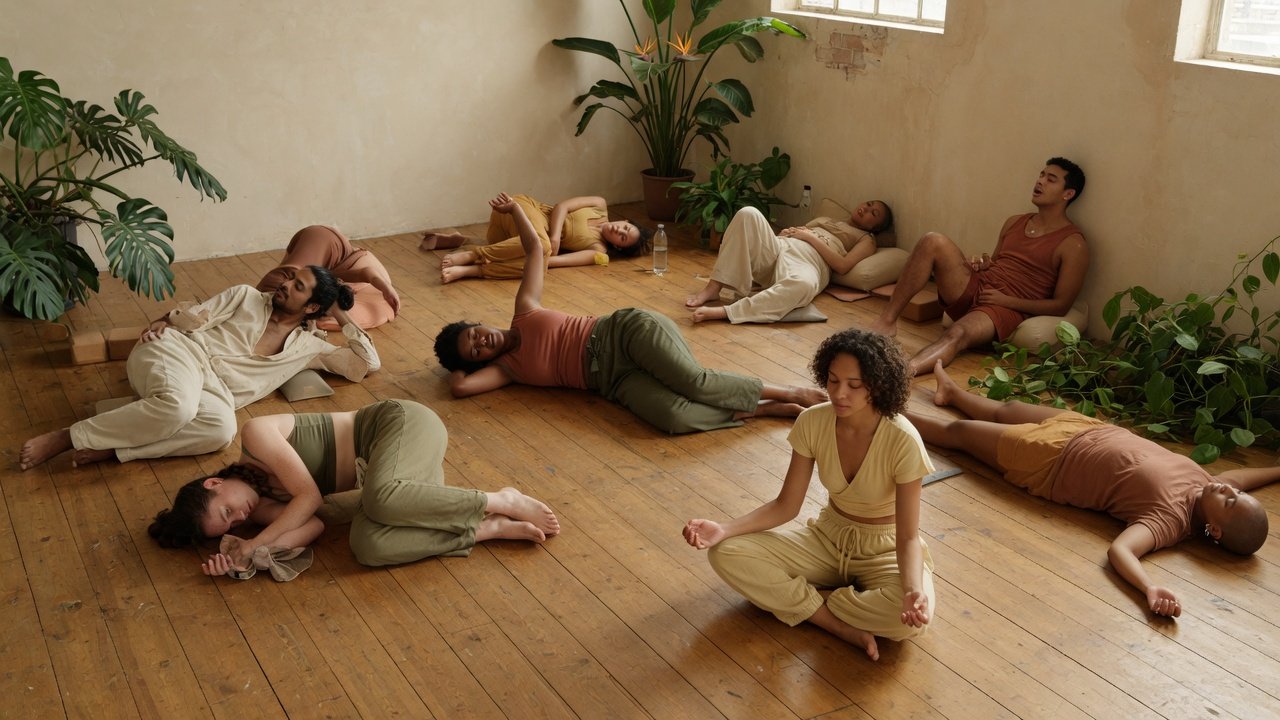
In Shaking Medicine, we create the conditions of safety, permission, and deep relaxation so that mechanism can wake again. There is no forcing. The tremor arises spontaneously when you soften and stop trying to control it.
The tremor is autogenic. It knows exactly what your system needs.

What It Feels Like
Therapeutic tremoring is not the same as making yourself bounce, vibrate, or “do a shake.” Voluntary shaking can be useful — and it is still surface-level. Therapeutic tremoring is involuntary. You soften until your nervous system moves you.
People often feel:
- Fine vibrations, waves, or deeper quakes moving through the body
- Spontaneous sounds, yawns, pandiculation — that full-body stretch-and-shake animals do
- Heat, tingling, emotion moving through, then a settled calm
- A shift from “on” into parasympathetic rest — the body’s natural downshift
Sessions vary. Sometimes the tremor is subtle. Sometimes it is big. Both are perfect as the body gives you what you need, and can be deeply regulating when they are met with safety and self-pacing.
How Shaking Medicine Practises It
Shaking Medicine is the conscious, safe practice of therapeutic tremoring. Founded through Dr. Keith Motes’ own unexpected spontaneous tremoring experience — and shaped by physics, Yoga, Qi Gong, Zenthai Shiatsu, indigenous shaking lineages, and modern somatic science — it is a yin, non-forceful path.
In practice we:
- Arrive in safety — presence, breath, nothing to perform
- Soften deeply — release the need to control
- Allow, don’t force — the involuntary tremor arises on its own; the body leads
- Rest and integrate — so regulation can land
Unlike approaches that use only one or two positions, Shaking Medicine explores dozens of shapes — standing, all fours, belly, side, back, and more — so the tremor can move through the whole body. We invite curiosity, intuition, playfulness, and creativity, while keeping the foundations that make the work safe and effective.
You can read more of the lineage in Roots of Shaking Medicine, and the science behind neurogenic tremoring in our Science chapter.
How It Differs from TRE
Shaking Medicine and TRE (Trauma Releasing Exercises) both centre on neurogenic therapeutic tremoring. Very few modalities in the world do that. We respect TRE deeply and share the same root mechanism.
The paths differ in style:
- TRE tends to be more structured and protocol-based, with a scientific lens and a primary focus on a few shapes (often the butterfly on the back) to reach the psoas.
- Shaking Medicine is more creative and full-body, weaving science with spiritual and indigenous wisdom, and exploring many tremoring shapes so the shake can move through every fibre.
They can complement each other. If you have trained in TRE, you are welcome here. For a fuller comparison, see Shaking Medicine & TRE: Key Differences and Similarities.
Who It Is For (and Who Should Go Gently)
Therapeutic tremoring is for people in many stages of life — beginners and long-time practitioners, people carrying stress and trauma, and people who already feel relatively well and want more vitality, presence, and self-regulation.
Go gently, and work with support, if you are in acute crisis, have significant medical concerns, or are unsure whether somatic shaking is right for you right now. Read our Safety Precautions before you begin, and consult a healthcare provider when needed. This work is educational and wellness-oriented — not a medical treatment or a replacement for licensed care.
How to Begin
The only real way to understand therapeutic tremoring is to feel it in your own body.
- Join our online community to learn and practise with guidance
- Explore 1:1 support and other offerings
- Or send us a message — tell us where you are, and we will help you find the next step that fits
Your nervous system already knows how to let go. Therapeutic tremoring is how it does it. Shaking Medicine is simply the remembering.
With Love,
Dr Keith R. Motes
Voices from the community
What people are noticing
Real words from the community. Discover 272 additional wins →